
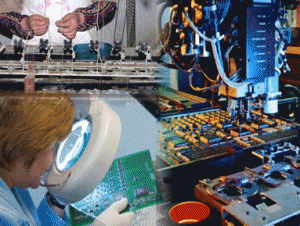
 Recent statistics show that manufacturing in the UK is now as low as 11% of GDP and employment in manufacturing has fallen by a massive 9% since Sept 2008.
Staggering figures – so what’s the solution, if in fact one is needed.
As manufacturing jobs are generally well paid compared to the rest of the economy and as each manufacturing role supports a number of others in the supply chain it would seem logical that an increase in the number of manufacturing jobs will lead to a more diversified and robust economy.
So, how do we go about generating more manufacturing jobs. Do we introduce tariffs on Chinese goods ? Impose extra duties on imports ? – we could do this but in the end we may do more damage to British business than good.
Many companies have survived by outsourcing activities to China, the Far East and elsewhere and whereas some would argue this has cost British jobs the counter argument is, that without outsourcing, these companies would have gone bust and cost even more jobs.
Capitalism is a dynamic competitive environment and, like its biological counterpart, the most able to adapt will survive.
Wherever a company or organization exists, in order to compete, survive and thrive it needs to Innovate.
It needs to develop new products and services and bring them to market.
In the current climate this is even more critical.
Innovation enables the most able to adapt to survive.

 Friday’s News that Automotive component supplier Bosch is closing its plant in South Wales and moving manufacturing to Hungary was grim news for employees.
 In a press statement released today at 21.oo GMT Father Christmas announced that, from today onwards, all toys will be manufactured by Chinese elves due to the increasing costs of employing elves at the North Pole. This has been exacerbated due to the effects of global warming and the shrinking ice cap making Real estate in the Northern Latitudes increasingly expensive.
 The recent events in Dubai, where the state owned fund “Dubai World” announced it needed an additional 6 months to repay some of its outstanding debt, caused shockwaves around the World echoing the problems of Lehmans 12 months ago. The impact was felt on stock exchanges from Hong Kong to Wall Street.