
Scientists published data this week to illustrate how humans ancestors were making tools 2.75 million years ago.
The story of technology is the story of humanity’s curiosity, ingenuity, and relentless quest for innovation marked by clear analysis, practical insight, and a touch of forward-thinking optimism—this blog embarks on a journey from the dawn of time to the present digital age to explore the remarkable evolution of technology.
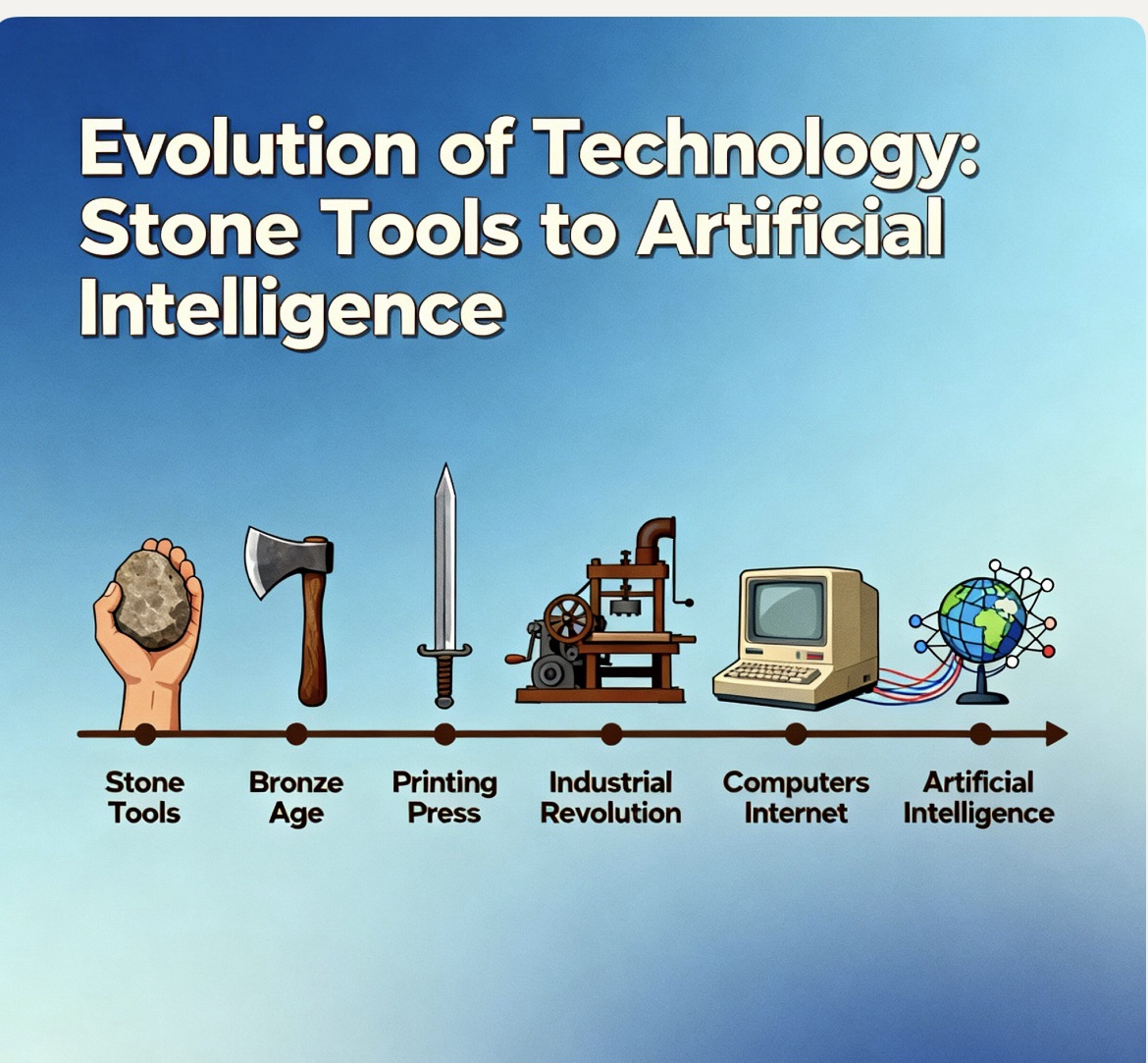
Human technological achievement began with the simplest acts—chipping stone to make cutting tools, harnessing fire, and crafting the earliest shelters. These early inventions were not merely objects of survival; they were embodiments of human adaptability. Every innovation, from the handaxe to woven baskets, enabled our ancestors to control their environment, marking the first steps on our technological journey.
More than resourcefulness, these inventions reflected humanity’s ability to learn and teach. Technologies such as the wheel and plough spread throughout emerging societies because humans, by nature, are storytellers who share knowledge across boundaries and generations.
As societies flourished, so did our technologies. The Bronze Age brought alloyed metals, revolutionizing not only tools and weapons but also art and commerce. This was followed by the Iron Age, which vastly improved agricultural productivity and military capability, catalyzing urbanisation and societal complexity.
The invention of writing systems—clay tablets in Mesopotamia, papyrus scrolls in Egypt—not only preserved information but amplified it, enabling coordination across vast empires. Ancient Greece’s mechanical devices, Chinese papermaking, and Roman aqueducts reveal how technology’s trajectory continually bent towards improved organization and quality of life.
Yet, it was the arrival of the printing press in the 15th century that truly democratized knowledge, planting seeds for the rapid innovation of the centuries to follow. The Industrial Revolution marked another quantum leap; steam engines, mechanized looms, and electricity transformed societies from agricultural to urban-industrial.
In the last 150 years, the pace of change has become exponential. The telegraph shrank the world; the light bulb extended productive hours; wireless radio and television made mass communication routine. Mid-20th century computing inaugurated new paradigms—a journey from room-sized calculating machines to billions of pocket-sized computers populating the globe.
The internet—perhaps the most revolutionary invention since the printing press—reshaped communication, commerce, and even social norms. It connected distant communities, enabled global collaboration, and fostered a free flow of ideas never before seen in human history.
Technology’s relentless progress has always shaped—and been shaped by—society’s attitudes and ambitions. The move from analog to digital shifted not just mechanics but mindsets as well. Today, artificial intelligence exponentially accelerates problem-solving, automation redefines industries, and biotechnology extends the boundaries of health and longevity.
Amid this dynamism, Amberhill Associates often reminds clients of a timeless lesson: that technology is only as beneficial as the intentions behind it. The integration of new tools must remain grounded in ethics, inclusivity, and real human needs.
As we stand on the brink of quantum computing, the deployment of smart infrastructure, and the integration of AI companions into daily life, the future promises both dazzling potential and complex challenges. The rapid evolution of technology will perhaps, more than ever, call for considered leadership, adaptability, and a commitment to wielding these tools for collective benefit.
Throughout history, those who have thrived are not simply the strongest or most intelligent, but the most adaptable to change. As trusted advisors, Amberhill Associates emphasizes not just keeping pace but anticipating shifts, cultivating versatility, and aligning innovation with core human values.
Technology’s story—from stone tools to smart machines—is ultimately a human one. It is a continuous legacy not merely of what we create, but how wisely, compassionately, and intentionally we choose to use it.
Chris@amberhill.biz